As mentioned at this link
, all 47 core column splices are at the same elevations separated by 3
floors in the region of interest (they are not staggered). There are
horizontal planes separated by 3 floors which contain all the splice
connections. The floors are 89, 92, 95, 98, 101, 104. The splice
locations are about 3 ft above the flooring. The splices in this region
are all bolted with no welds.
Rather important because the building failed through the 98th floor at
an angle of less than 1 degree. The failure angle was within 1 degree of
plumb so the splice connections are the natural place to look for
weakness.
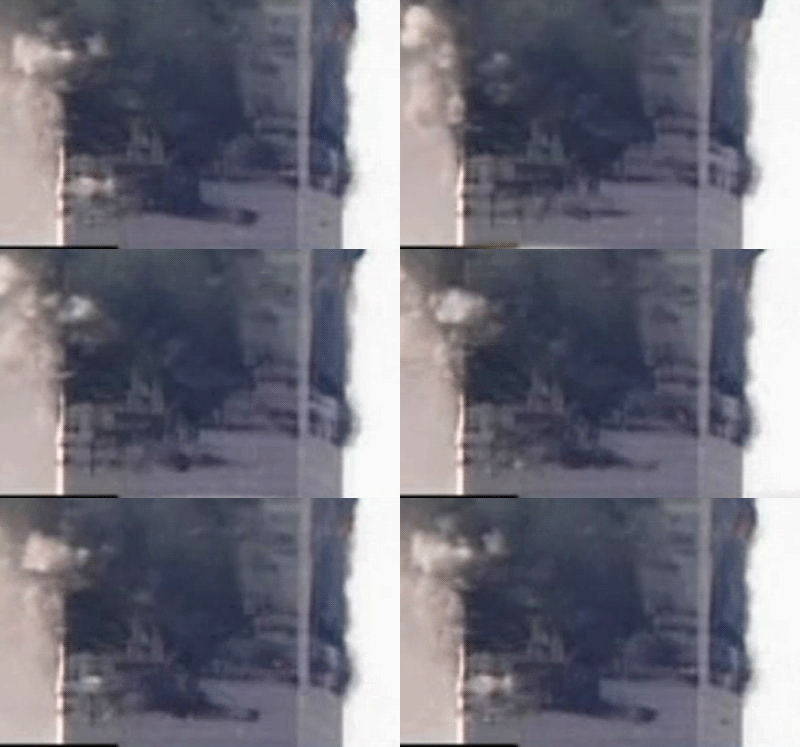
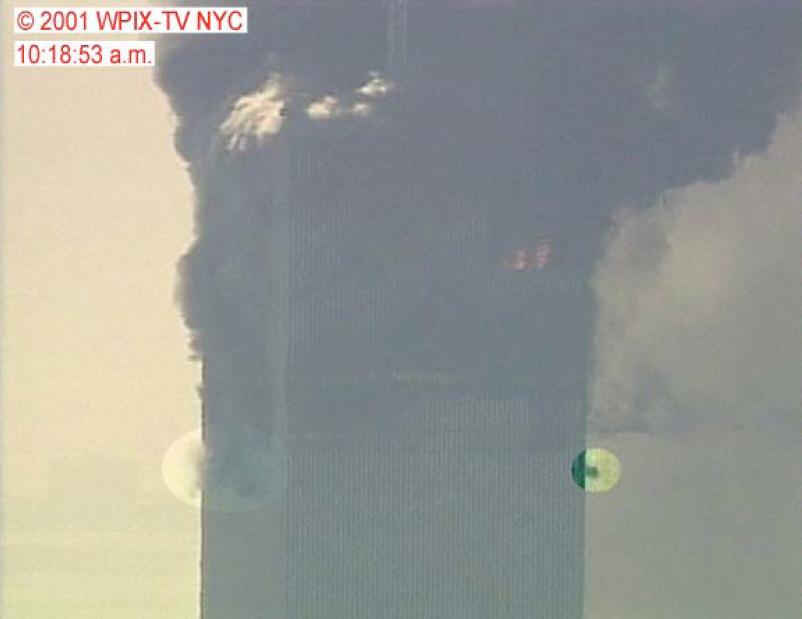
The smoke ejections in the previous gif are on the 95th and 92nd floors.
So, initiation on floor 98 and the smoke ejections on fls 95 and 92.
Core column bolted splices would be a natural target in the cse of
demolition. They are also the main structural weakness in the case of
the buildings failing naturally. Why cut columns if they are already
cut and held together with only bolts and bolt plates? It is much easier
to just crack the bolted splice plates and displace the columns
slightly. Much less energy required.
The NIST offers the following comments on the event and nothing else:
"At 10:18:48 a.m., a pressure pulse pushed large amounts of smoke and fire out of open windows on
multiple floors and faces of WTC 1. The most dramatic effect of this
pressure pulse was on the 92nd floor, where a long line of smoke
appeared from open windows on the north face. Up until this time, there
had been very little smoke coming through the open windows from the
widespread fires burning on this floor. During the final ten minutes
prior to the collapse of WTC, a large fire grew on the 92nd floor in the
large open area on the west side of the north face. A large burst of
fire was pushed from the area when WTC 1 collapsed. The pressure pulse
at 10:18:48 a.m. also seemed to cause a fire burning in a room in the
northwest corner of the 95th floor to suddenly intensify and to extend
flames from north face windows."
-NCSTAR 1-5A Draft, p 290
...............
"Two pressure pulses that were large enough to force smoke and fire from
open windows on multiple faces and floors were observed during the
period. The first occurred at 10:18:48 a.m. and the second just seconds
prior to the collapse of the tower at 10:28:22 a.m. The sources for
these pressure pulses are unknown, but it seems likely that they
resulted from significant structural changes within the tower."
p 280
................
"With the exception of the fires that grew on the 96th and 97th floors
shortly after the aircraft impact, it has generally been observed that
very little smoke and/or extended flames flowed from open windows on the
north face where fires were visible. This has been interpreted to
indicate that the smoke from these fires was venting elsewhere within
the tower. The fact that smoke and fire continued to vent from the north
face following the pressure pulse may be an indication that the
internal ventilation pathways were
changed as the result of the event responsible for the pressure pulse."
p 257
...................
"At 10:18:48 a.m. an event took place within the tower that created a pressure pulse of sufficient
magnitude to force smoke out of numerous windows on the north face, as
well as from the other faces. The most obvious effect of this pressure
pulse was the release of a dense line of smoke along a length of the
92nd floor on the north face, extending from roughly window 94-110 to
window 94-139. This smoke release was evident in numerous videos,
including a number shot at great distances. Figure 8-95 compares two
frames taken from a video showing the north face just prior to the smoke
release and the appearance just over 4 s later. Even though the video
was shot from a distance, the line of smoke that has appeared from the
92nd floor is readily apparent. It is significant that until this time
very little smoke had been observed coming from the open windows on this
floor, even though fires had been burning on the floor for some time.
Closer inspection of this video, as well as others, shows many
additional effects of the pressure pulse at other locations on the
tower. Smoke and/or dust were pushed out of windows on the east side of
the north face at the 94th floor. This material is responsible for the
light-colored 'smoke'� seen near the eastern
edge of the building immediately above the darker smoke released from the 92nd floor in Figure 8-95."
p 253
>>>>>>>>>>>>>
Kind of odd how this event can send pulses through fls 98, 95 and 92 at
the same time and be seen along fl 92 on the SW corner. The reference
to 94 is a slight drifting of grey smoke along the east side of the
north face reflected by the sun while emerging from a shadow. It is not
an ejection as the NIST claimed.
This video shows how the fires spread over the north face over time.
Note how the fires along the 92nd floor appeared and spread as a result
of the structural change which occurred at 10:18 (0:57 in the video).